Thursday, July 30, 2015

Spinal CORD Syndrome

Spinal CORD Syndrome


The spinal cord ends at the intervertebral disc between the first and second lumbar vertebrae as a tapered structure called the conus medullaris, consisting of sacral spinal cord segments. The upper border of the conus medullaris is often not well defined. The fibrous extension of the cord, the filum terminale, is a nonneural element that extends down to the coccyx.

The cauda equina (CE) is a bundle of intradural nerve roots at the end of the spinal cord, in the subarachnoid space distal to the conus medullaris. Cauda is Latin for tail, and equina is Latin for horse (ie, the "horse's tail"). The CE provides sensory innervation to the saddle area, motor innervation to the sphincters, and parasympathetic innervation to the bladder and lower bowel (ie, from the left splenic flexure to the rectum).

AF Amiodarone Or Digoxin


AF Amiodarone Or Digoxin


Atrial Fibrillation (AF) is by far the most commonly encountered in the Emergency Department and is associated with the potential for serious consequences including stroke, deterioration of underlying cardiac disease, prolonged hospital stay, and increased mortality. 

AF is an irregular, disorganized, electrical activity of the atria characterized by absent P waves and an irregular baseline on ECG.

ADRENAL Crisis

ADRENAL Crisis

Adrenal crisis and severe acute adrenocortical insufficiency are often elusive diagnoses that may result in severe morbidity and mortality when undiagnosed or ineffectively treated.

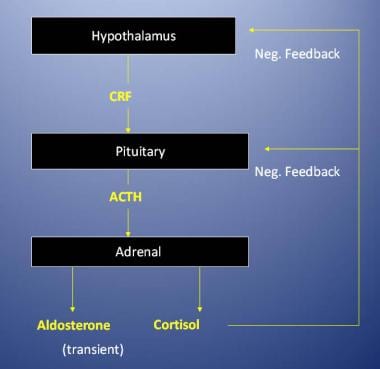
Although it is thought by experts that more than 50 steroids are produced within the adrenal cortex, cortisol and aldosterone are by far the most abundant and physiologically active. Regulation of the adrenal cortex is illustrated in the image below.

Wednesday, July 29, 2015

ADDISON Hyperpigmentation


ADDISON Hyperpigmentation


Addison disease is an autoimmune disorder in which the body attacks the adrenal glands, effectively shutting them down. Patients end up with a whole host of problems, including hypotension (from the lack of mineralocorticoids) and hypoglycemia (from the lack of cortisol). 

As the disease progresses, the adrenals put out less and less cortisol. The pituitary sees that drop in cortisol levels and responds by making more ACTH. ACTH is derived from a bigger precursor molecule called pro-opiomelanocortin (POMC). POMC is also a precursor for beta endorphin and melanocyte stimulating hormone (MSH) , so if you make more POMC (in order to make more ACTH), you’ll make more beta endorphin and MSH.

The beta endorphin doesn’t do much, as far as I know, but the MSH stimulates melanocytes, giving the skin a bronze color. Sometimes it’s an all-over bronze, like a tan (as in the photo above), and sometimes it’s more localized (in the gums, or in areas subjected to increased pressure, like over the knuckles or in skin folds).

However the bronze color manifests, it’s a telltale sign that the patient’s adrenal failure is primary (localized to the adrenal) and not secondary (due to hypopituitarism). In adrenal failure due to hypopituitarism, the whole problem is that the patient isn’t making ACTH (and thus the adrenals aren’t putting out their products) – so there’s no increase in MSH production and no hyperpigmentation.

Sunday, July 26, 2015

START Triage

START Triage : Sorting of Patients

  1. You can’t commit to “one-on-one” care 
  2. You have to be fast – 30 sec or less per patient 
  3. Very limited treatment is provided 
  • Manually open airways 
  • Clear airway with finger sweep 
  • Control major bleeding Primary and Secondary Triage